

Quilling, or paper twisting, is an amazing art in which long and narrow strips of paper are transformed into delicate lace that can rival jewelry. The name itself comes from the English word quill - a bird's feather, which served as the first tool for winding paper . This art, full of tenderness and painstaking labor, has come a long way from imitation of precious metals in poor churches to the status of a global hobby and high decorative art. Let's trace this fascinating evolution.
⛪ Historical Roots: Gold for the Poor
The origins of quilling go back centuries. Some researchers suggest that the rudiments of the technique may have existed in ancient Egypt, where thin metal strips were used for decoration. However, the true birth of paper twisting as an art occurred in medieval Europe in the late XIV - early XV century.
The main inventors of the technology were Catholic nuns in France and Italy. During the Renaissance, they created delicate medallions, icon frames and religious book covers. They used strips of paper with gilded edges that they cut from the covers of old folios. By threading these strips onto the tip of a goose quill, they created openwork patterns that, when viewed up close, created the full illusion of gold filigree. In poorer churches, this imitation of precious settings was the only luxury available, and the technique was poetically called gold for the poor.
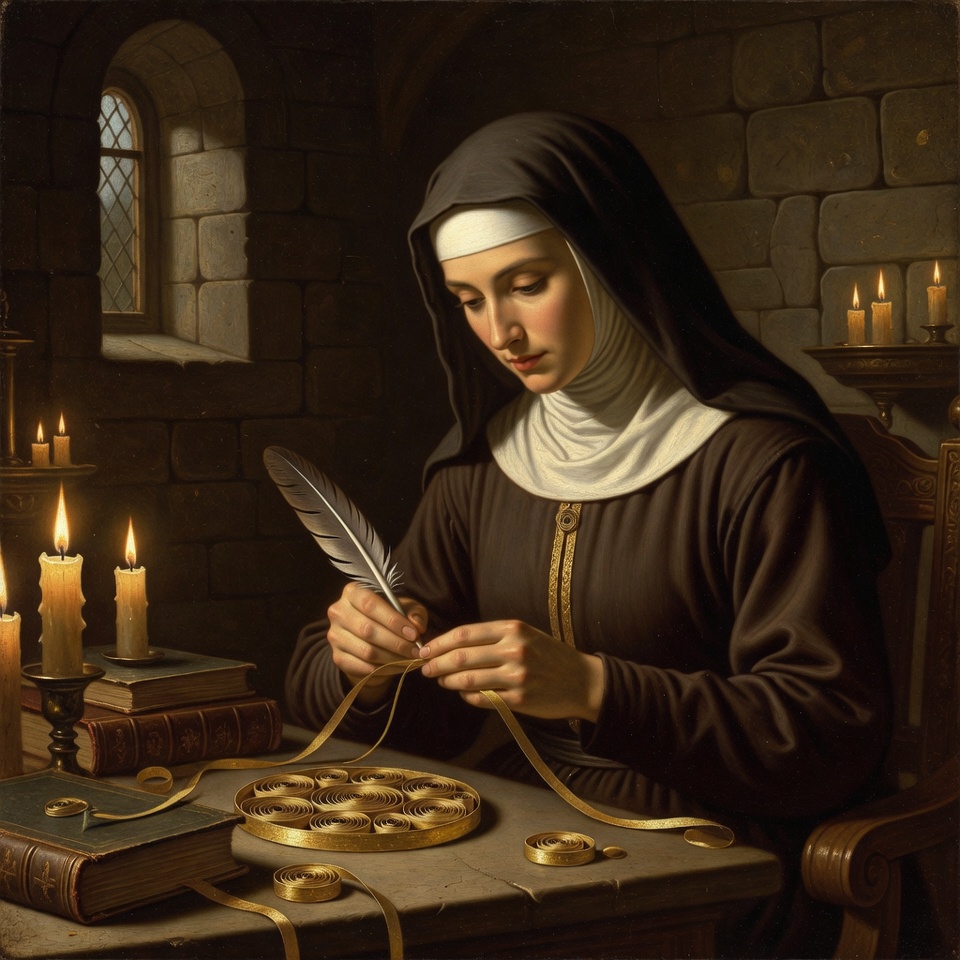
👑 The age of gentlemen and noble ladies.
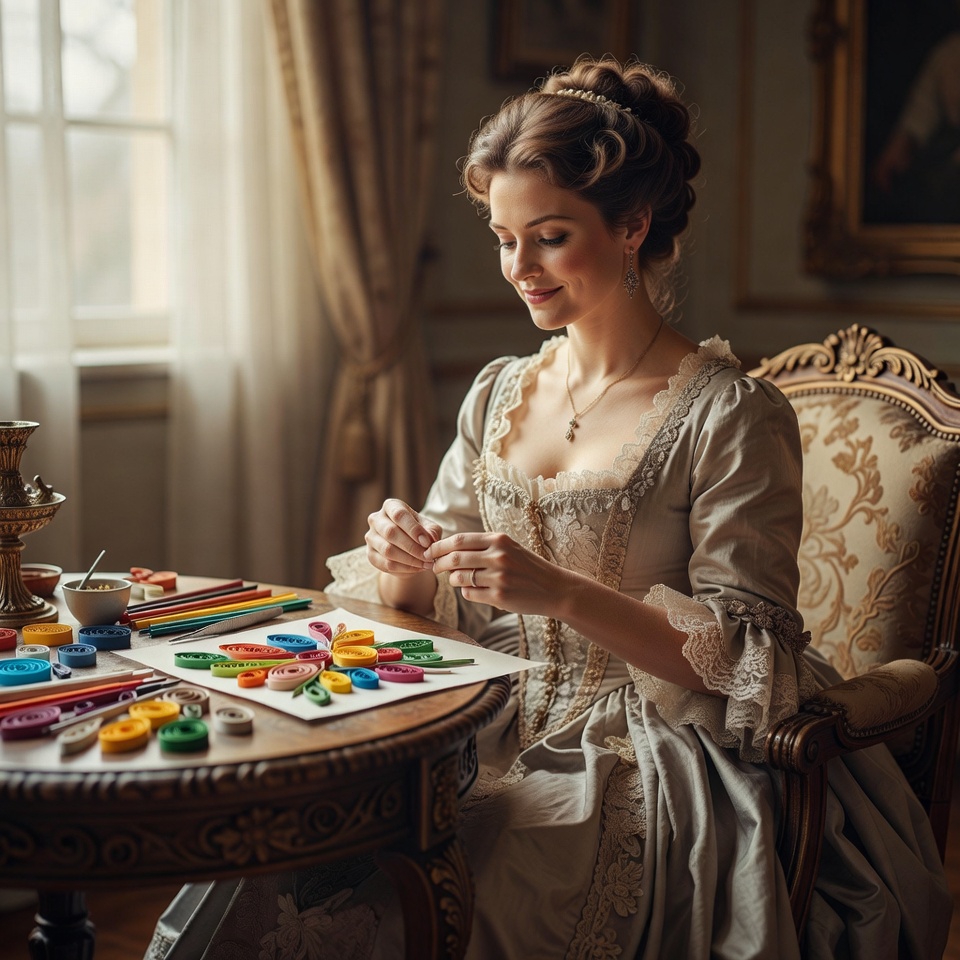
In the XVII-XVIII centuries, quilling went beyond the walls of monasteries and became a refined social entertainment. However, due to the high cost of quality paper and the need to have a lot of free time, this art remained the domain of the rich and noble.
In England, where the first paper mills appeared around 1495, quilling was particularly widespread. It was practiced by ladies who were not burdened with work, along with embroidery and other types of women's needlework. It was considered an innocent pastime to fill an hour of leisure (The New Lady's Magazine, 1786).
Sophisticated ladies decorated tea boxes, work baskets, screens, cabinets, picture frames and even pieces of furniture with paper curls, for which special recesses were made. It is known that such celebrities as the writer Jane Austen (she mentions filigree work in her novel Sense and Sensibility) and the Brontë sisters paid tribute to the hobby. At the end of the XVIII century, Princess Elizabeth, daughter of King George III, was seriously interested in quilling, and some of her works are still kept in the Victoria and Albert Museum in London.
🌍 Regional variations and revitalization
In the XIX century quilling remained predominantly a ladies' pastime, but by the beginning of the XX century its popularity faded. Interest was revived only in the second half of the 20th century. In 1875, Englishman William Bemrose tried to bring the art back to life by publishing a set of Mosaicons with instructions, and in 1927 one of the first major exhibitions was held in London.
Today there are two distinct schools of quilling, which were formed by the end of the XX century :
- European School: It is characterized by brevity and minimalism. Works, as a rule, consist of a small number of details and resemble a mosaic, decorating cards, frames and gift wrapping. Here the important thing is a quick and decorative result .
- Korean (Oriental) School: This is true virtuosity. Oriental masters, who have absorbed the traditions of the finest graphics, create the most complex works, similar to jewelry art. The finest three-dimensional lace is woven from hundreds of small details, turning into luxurious panels and paintings.
✨ Cultural significance and symbolism
Quilling has always had a deep cultural connotation. In the Middle Ages, it was a symbol of religious humility and at the same time an attempt to touch divine beauty through the imitation of gold. In the Victorian era, it became a marker of social status and good upbringing for high society girls, a symbol of idleness and refined taste.
Today, quilling is a symbol of harmony and patience. The technique itself, which requires meticulous twisting and patterning, is often used in art therapy to help calm the mind, develop fine motor skills and focus on the beautiful. This art teaches us to see the potential in the simplest of materials and to create complex beauty from nothing, in fact, from waste paper.
Unlike origami, where the form is born from the geometry of folding, in quilling the form is born from the curve of the line, from the endless spiral movement, which gives the works a special liveliness and organicism. Today quilling is experiencing a new heyday: from modest postcards to exhibition panels and even jewelry, proving that paper lace does not lose its appeal in the digital age.
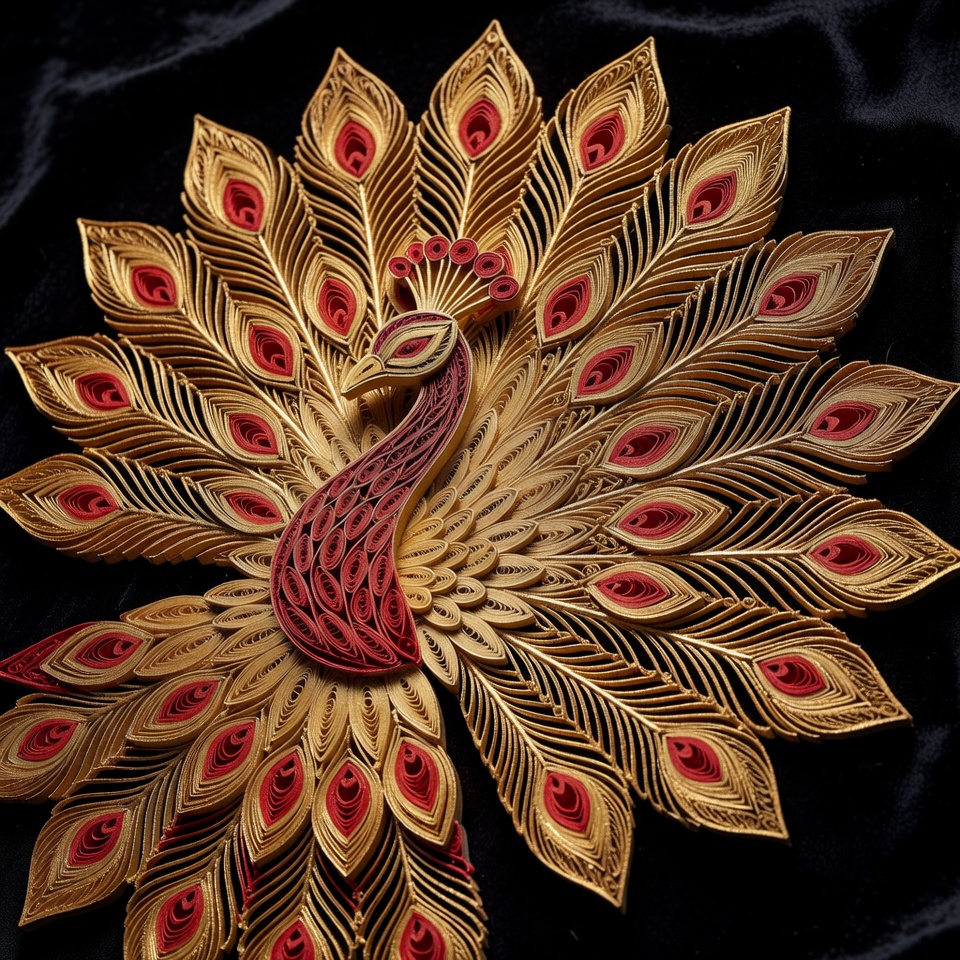
We invite you to try your hand at this amazing art and perhaps create your own little masterpiece, continuing the centuries-old history of paper twisting!





 English
  Русский
  Українська
  Français
  Italiano
  Español
  Deutsch
  Čeština
  Polski
  Български
  Português do Brasil
  Bahasa Indonesia
  Türkçe
  العربية
